
Checking Criminal History in Ladysmith
Ladysmith has four practical record routes. Ladysmith Police keep city incident and arrest reports. Ladysmith Municipal Court keeps ordinance and citation files. The Rusk County Jail publishes current custody PDFs, and the Rusk County Circuit Court handles state criminal filings from Ladysmith. No Ladysmith portal joins these records, so start with the event type and move only as far as the question requires.
- Contact Ladysmith Police for a city incident or arrest report and describe the event as precisely as possible.
- Use the city public-record form for a written request, or ask how to submit the request directly to the legal custodian.
- Call, fax, mail, or visit Ladysmith Municipal Court for ordinance and citation records because no online municipal case search exists.
- Use the Rusk County Jail list for a current custody trace and WCCA for a state criminal case filed in Circuit Court.
- Use WORCS only when an official statewide Wisconsin CIB history is the actual need, especially for review of one's own record.
The official Ladysmith Police page identifies the department and its contact route.
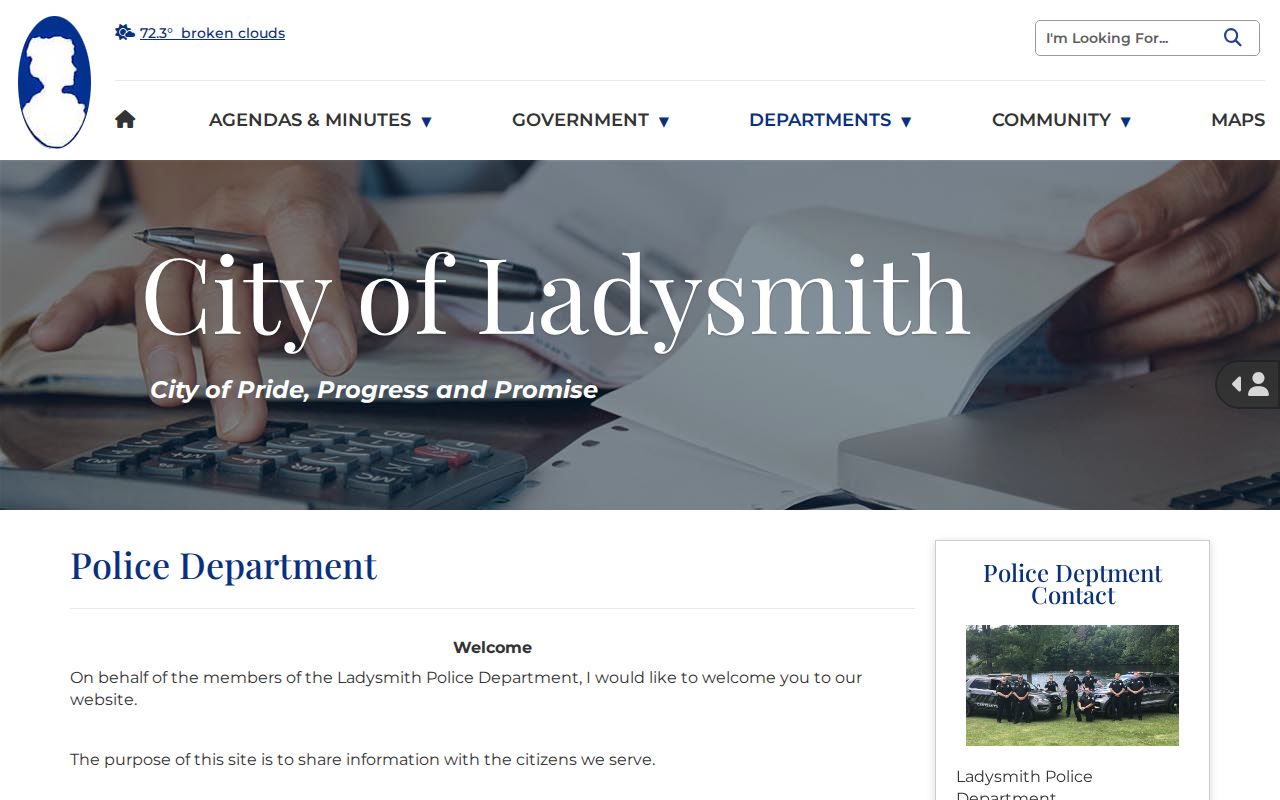
That city office is the right first custodian for an LPD report, not the county Clerk or District Attorney.
Ladysmith Records Start Differently
Ladysmith is Rusk County's only incorporated city and the only municipality in the county with its own police department. The Sheriff is primary elsewhere. This Ladysmith boundary determines who holds the first report. A Ladysmith event begins with LPD records even though the Ladysmith Police Department and several county justice offices use addresses on East Miner Avenue.
Ladysmith had 3,216 residents in the 2020 Census. That number identifies the official Ladysmith population base, but no verified LPD annual crime table was found. County calls for service and Sheriff workload totals must not be labeled as Ladysmith crime rates. For later Ladysmith statistics, use an exact Ladysmith agency and year from Wisconsin DOJ UCR data rather than borrowing a county total.
Ladysmith Police Department Records
The Ladysmith Police Department is at 311 East Miner Avenue. Chief Kevin G. Julien is the legal custodian for Ladysmith police records under City Title 3. The Ladysmith office phone is 715-532-2186, fax 715-532-9460, and published email is ke219@ruskcountywi.us. Ladysmith does not list a separate public records-desk schedule, arrest blotter, report portal, mobile app, or app-only lookup.
LPD records can include the Ladysmith incident date and place, responding officers, alleged conduct, arrest facts, property or evidence, and transport details. Public Ladysmith copies may remove protected victim, witness, juvenile, or personal data. Ask for the public or redacted part if the whole Ladysmith report cannot be released. A Ladysmith police report records the agency's response and allegation; it does not prove guilt or replace a later court judgment.
Ladysmith Police Department
311 East Miner Ave.
Ladysmith, WI 54848
715-532-2186
Fax: 715-532-9460
Email: ke219@ruskcountywi.us
Ladysmith Records Sought Form
The Ladysmith public-record request form uses a simple narrative field rather than a menu of police records.
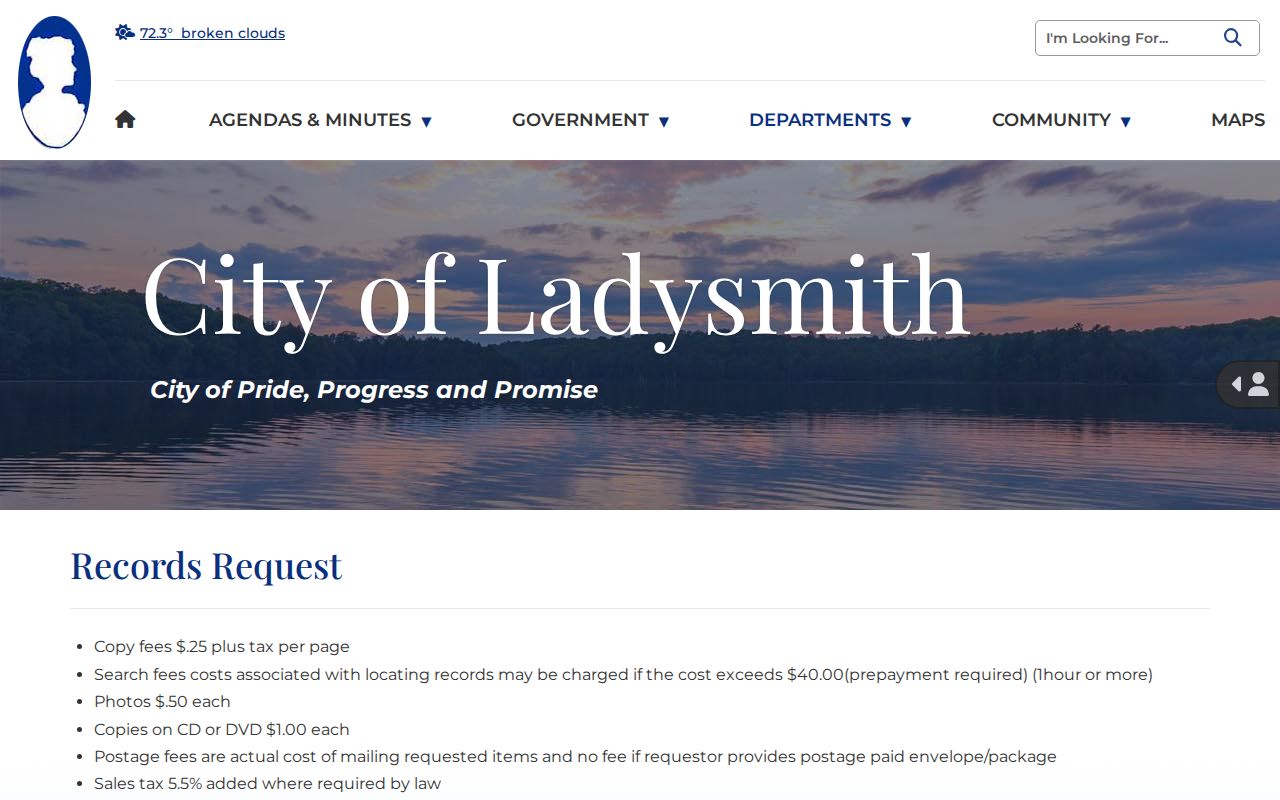
The form's design means the wording placed in “Records Sought” does much of the work.
The Ladysmith form asks for the requester's name, address, city, state, ZIP, telephone number, date, and a description of the records sought. “Date Filed” and “Fee” are Ladysmith office fields. The form shows no checkbox list, mandatory markers, ID or notary condition, or promised response time. State the Ladysmith incident date, location, report number if known, agency, type of public record, and desired format. Those details reduce ambiguity without being presented as Ladysmith prerequisites.
Ladysmith paper copies cost $0.25 plus tax per page, photos cost $0.50, and a CD or DVD costs $1. Actual postage and 5.5% sales tax may apply. Ladysmith location or search work may require prepayment when the cost exceeds $40, described by the city as one hour or more. Request a Ladysmith estimate before broad wording creates avoidable search cost.
Ladysmith Arrests and Bookings
LPD advertises no Ladysmith jail or Ladysmith roster. The county jail's dated PDF is the apparent official public custody route after a Ladysmith arrest that results in county booking. Research found no formal Ladysmith booking agreement, so the PDF should not be described as proof that every LPD arrest goes there. A Ladysmith citation, quick release, transfer, or event too new for the file may not appear.
Use three distinct contacts. Ask Ladysmith Police for the incident or arrest report. Ask the Rusk County Jail or Sheriff about current custody and booking records. Search WCCA or ask the Rusk County Clerk after state charges may have been filed. The fuller county process is covered in the Rusk County arrest lookup, while the city question stays focused on which Ladysmith source created the first record.
Note: A missing name in the dated jail PDF does not rule out a Ladysmith arrest, citation, release, or transfer.
Ladysmith Citation or Criminal Case
Ladysmith Municipal Court has exclusive jurisdiction over Ladysmith ordinance violations punishable by forfeiture. It handles Ladysmith traffic and nontraffic LPD citations as well as Rusk Animal Control citations. These Ladysmith matters are civil, not Wisconsin criminal misdemeanors. That distinction prevents a common Ladysmith records error: a municipal guilty finding is not the same thing as a state criminal conviction.
A Ladysmith state-law felony or misdemeanor goes to the Rusk County Circuit Court, not the Ladysmith city court. WCCA may then show the public docket, charges, hearings, plea, disposition, sentence, and financial events. The Ladysmith Municipal Court file stays with its clerk. When the issuing paper or notice does not make the forum clear, call the Ladysmith court named on it before searching a statewide criminal docket.
- Forfeiture
- A civil money judgment for an ordinance violation, not a criminal sentence.
- No contest
- A plea that leads to a guilty finding but cannot be used in another civil proceeding.
- State charge
- A criminal allegation prosecuted in Rusk County Circuit Court rather than Municipal Court.
Municipal Court Records in Ladysmith
The Ladysmith Municipal Court page identifies the court's city ordinance scope and location.
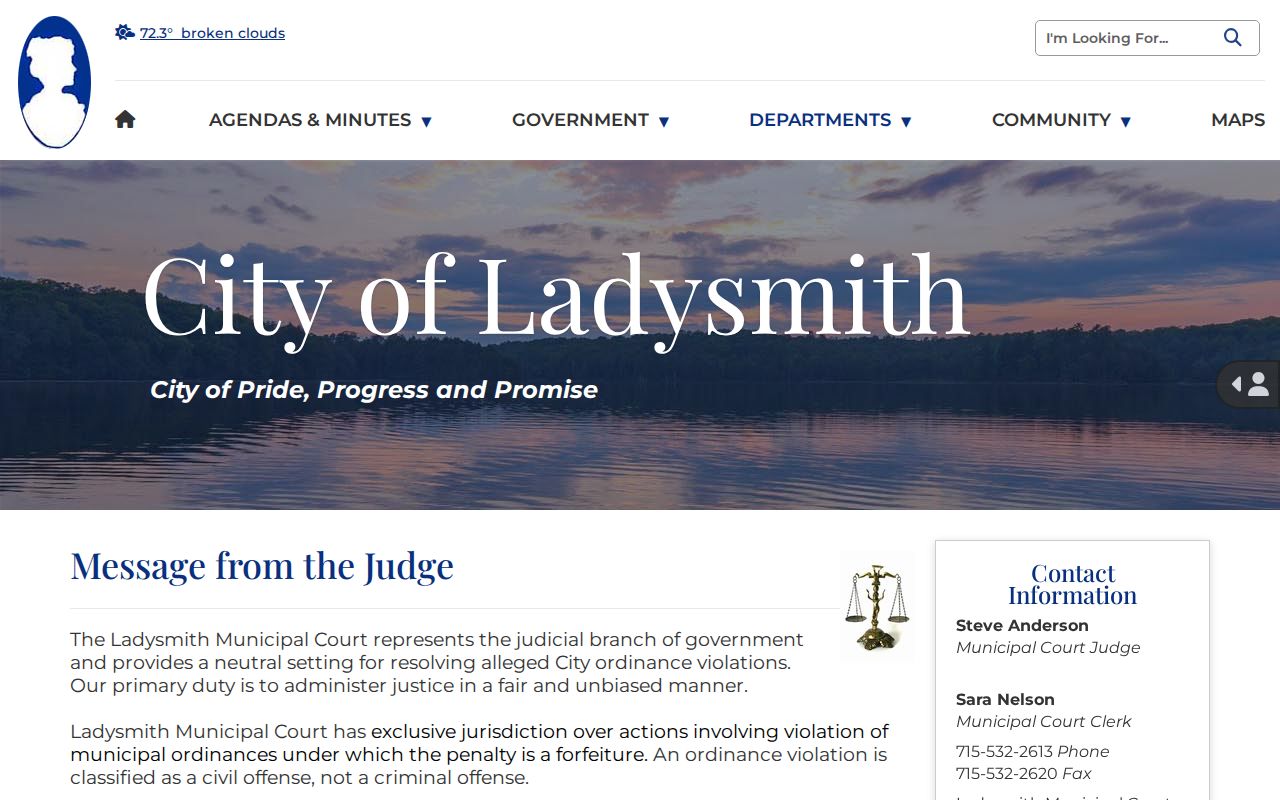
The court sits at 120 West Miner Avenue, apart from the police and county offices on East Miner Avenue.
Judge Steve Anderson and Clerk Sara Nelson are the published court contacts. Call 715-532-2613 or fax 715-532-2620. Mail goes to PO Box 431, Ladysmith, WI 54848. There is no online municipal case-search portal. Online payment is only a payment channel and does not expose a docket.
| Court | Ladysmith Municipal Court |
|---|---|
| Cases | City ordinance, traffic, nontraffic LPD, and Rusk Animal Control citations |
| Legal character | Civil forfeiture matters, not state criminal prosecutions |
| Record channels | Phone, fax, mail, or counter request |
| Copies | Supervised inspection of originals and copies at $0.25 per page |
| Exception | Juvenile cases are specifically identified as restricted |
Ladysmith Court Records Stay Offline
The Municipal Court records instructions provide the official substitute for a search portal.
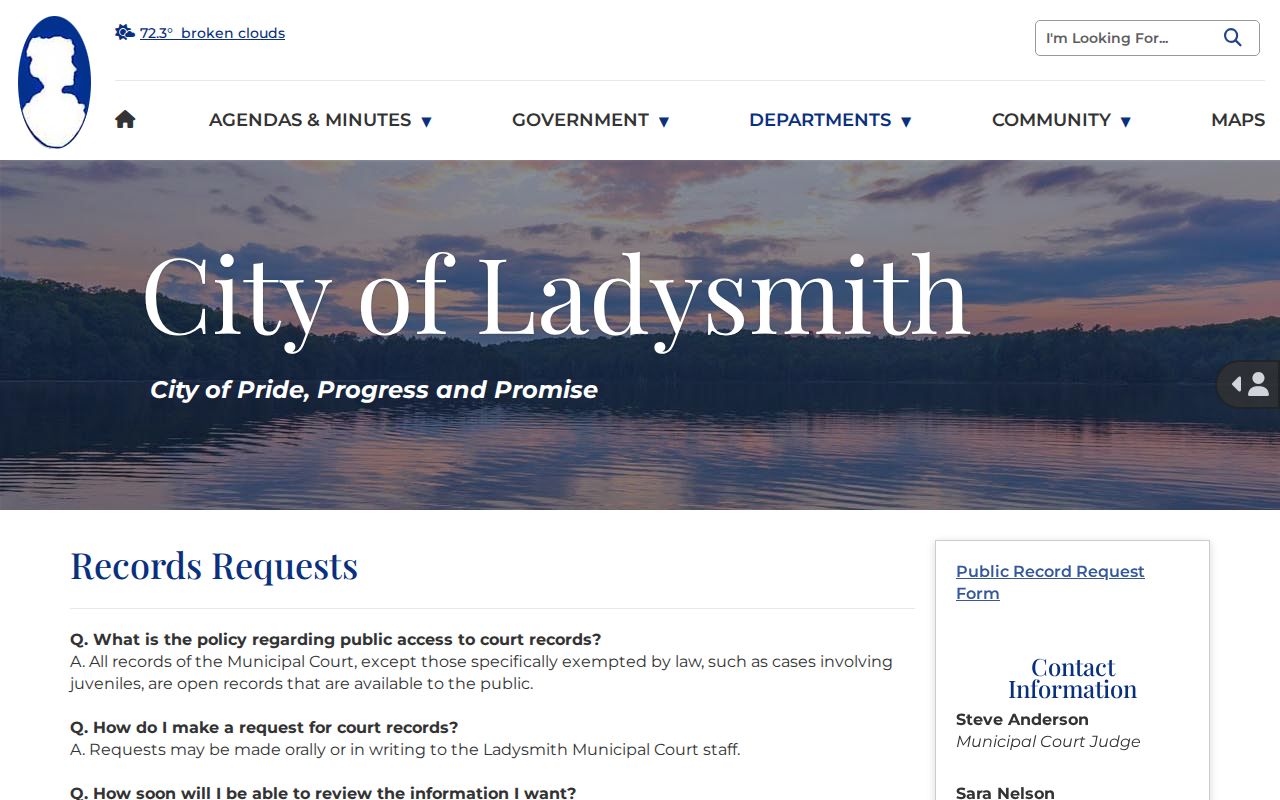
The instructions confirm four routes: phone, fax, mail, and the court counter.
Requests may be oral or written. The court aims to fill a request within 24 hours or tell the requester when the record will be available. Originals remain under staff supervision, and copies cost $0.25 per page. Juvenile cases are a stated exception. The drop box at the front entrance to City Hall is useful for filings or payments, but it is not a public case lookup.
Give the clerk the citation number, party name, approximate date, and record sought when known. Ask whether the case is a municipal citation or a state charge before assuming the city holds it. This keeps a narrow Ladysmith inquiry from turning into an unnecessary county-wide search.
Ladysmith Citation Calendar
The official Ladysmith court calendar lists the recurring Tuesday sessions.
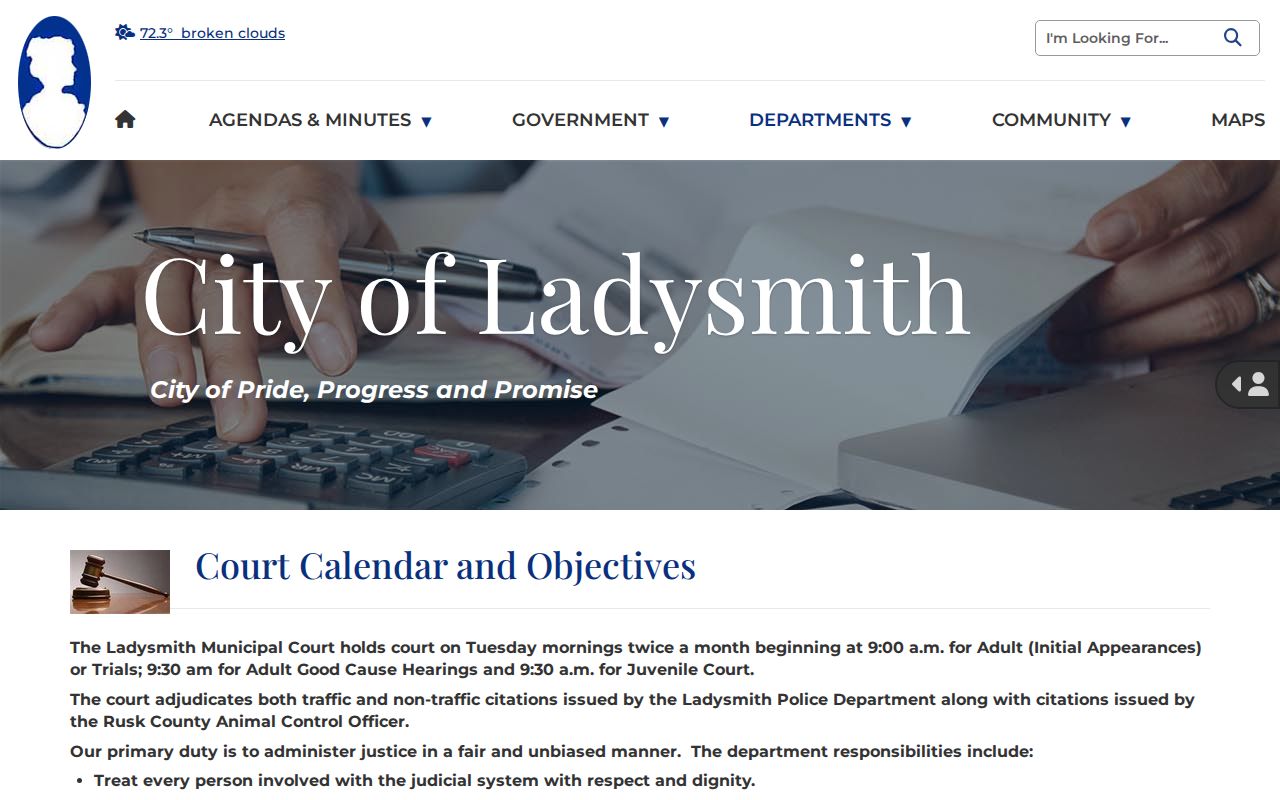
The calendar helps explain when a plea, trial, or judgment event may be added to a Ladysmith municipal file.
Adult initial appearances occur at 9:00 a.m. on the second Tuesday. Juvenile initial appearances and good-cause hearings follow at 9:30 a.m. Trials are held at 9:00 a.m. on the fourth Tuesday. These are the published recurring times, not a promise that every matter appears on a given session.
A not-guilty plea moves to a telephone pretrial with the City Attorney and then to trial if no agreement resolves the case. Ignoring a citation can lead to a default guilty finding, a Notice of Judgment within a week, and a 60-day payment deadline. A later good-cause or indigency hearing may address nonpayment.
Where Ladysmith Records Go
A Ladysmith police event can stay a city report, become a municipal citation, or be referred for a state criminal charge. LPD retains its incident record. Municipal Court retains its forfeiture file. A state prosecution moves to Rusk County Circuit Court, where the Clerk maintains the public case file and WCCA republishes the public docket data.
Record flow: Ladysmith Police › Rusk County Circuit Court › Wisconsin Department of Justice Crime Information Bureau.
The line applies when a city arrest leads to a qualifying state criminal case. It does not mean each LPD contact becomes a county prosecution or CIB entry. Fingerprint-supported arrest data can reach CIB, then prosecution, court disposition, and sentence updates may be matched later. For a recent city event, start with LPD. For the filed state case, use the Clerk or WCCA. For statewide self-review, use WORCS.
Ladysmith Records After Judgment
A Municipal Court judgment does not always end the file. An appeal goes to Rusk County Circuit Court through a Notice of Appeal and fee filed within 20 days. The exact current appeal fee was not located in the official city research, so confirm it with the clerk instead of relying on an old schedule.
The appeal creates a county court layer, but the original municipal matter remains an ordinance case. This is another reason to keep the city and county sources distinct. A reader tracing the matter may need the Ladysmith Municipal Court file for the citation and plea, then the Rusk Circuit Court record for the appeal. The broader Rusk County criminal history overview explains county and statewide channels without changing the city record's origin.
Public Access Rules in Ladysmith
Ladysmith Police and Municipal Court records are subject to Wisconsin access law and record-specific limits. The city may supervise inspection, charge lawful copy and location costs, and redact protected information. A denial should rest on a legal basis. Ask for the part that can be separated and released when a report contains both public and restricted content.
Key Statutes:
Wisconsin Public Records Law, Wis. Stat. § 19.35 gives a presumptive right to inspect or copy records, subject to statutes, balancing, and redaction.
Wis. Stat. § 165.83 governs CIB collection and helps explain why a city report and statewide history differ.
Wis. Stat. § 165.84 addresses qualifying fingerprint and criminal-history submissions to the state repository.
Wisconsin law calls for a response as soon as practicable and without delay rather than within one fixed statewide deadline. The Municipal Court's 24-hour target is its own published service goal. Juvenile records, protected identifiers, and victim or witness information can remain restricted even when the rest of a Ladysmith record is public.
Ladysmith Records Along Miner Avenue
Ladysmith's justice offices are close in distance but separate in legal custody. Police use 311 East Miner Avenue. The Rusk County Sheriff, jail, Circuit Court Clerk, and District Attorney also work from the county Government Center complex there, in different suites. Municipal Court is at 120 West Miner Avenue. Walking to the wrong door can still mean asking the wrong custodian.
The same corridor reflects Ladysmith's rail history. Old Smokey, the Soo Line locomotive and passenger cars, and the Worden Avenue industrial area mark the city's role as a river and rail center. That local setting is useful for place identity, not as a crime claim. For records, the practical lesson is simpler: name the agency and court in each request, even when the offices seem to share one part of town.